What This Guide Covers
A parking mistake in Melbourne can cost you close to a thousand dollars within minutes. The fee depends entirely on which type of tow happens to you: an accident tow, a clearway tow, or a council-impound tow.
Most drivers find this out the hard way, standing on a curb staring at an empty parking spot. This guide breaks down exactly what you’ll pay, why tow-away zones exist, and how to get your car back without losing more money than necessary.
The numbers below come directly from Transport Victoria, the Essential Services Commission, and the City of Melbourne. No estimates, no guesswork.
How Much Does Towing Cost in Melbourne
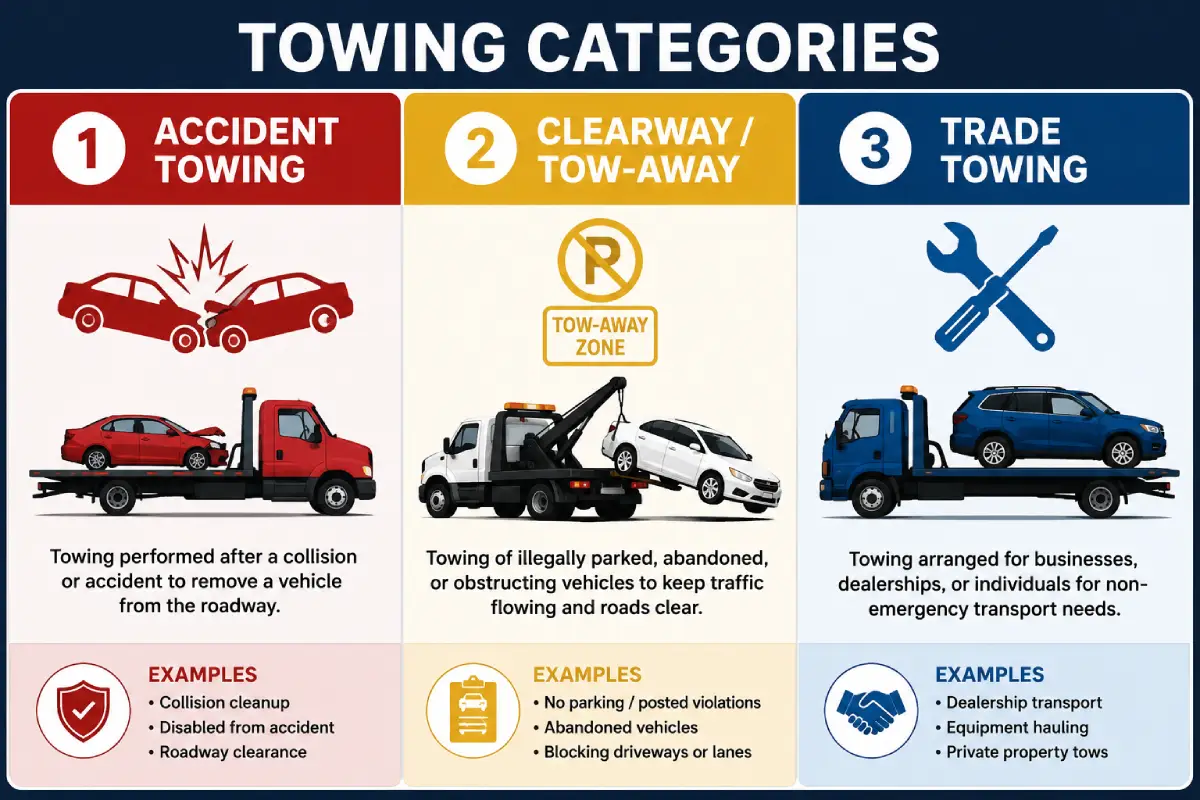
Towing in Victoria splits into two completely different fee systems depending on why your car got towed.
Accident towing is government-regulated. A fixed base fee applies regardless of which operator shows up.
Clearway and tow-away zone towing is a council and Transport Victoria enforcement action. It carries a flat release fee plus daily storage if you delay collection.
Trade towing (breakdowns, private tows you arrange yourself) is deregulated. Operators set their own prices, so shop around before agreeing to a callout.
These three categories are not interchangeable, and the fee you owe depends entirely on which one applies to your situation.
Accident Towing Fees in Victoria
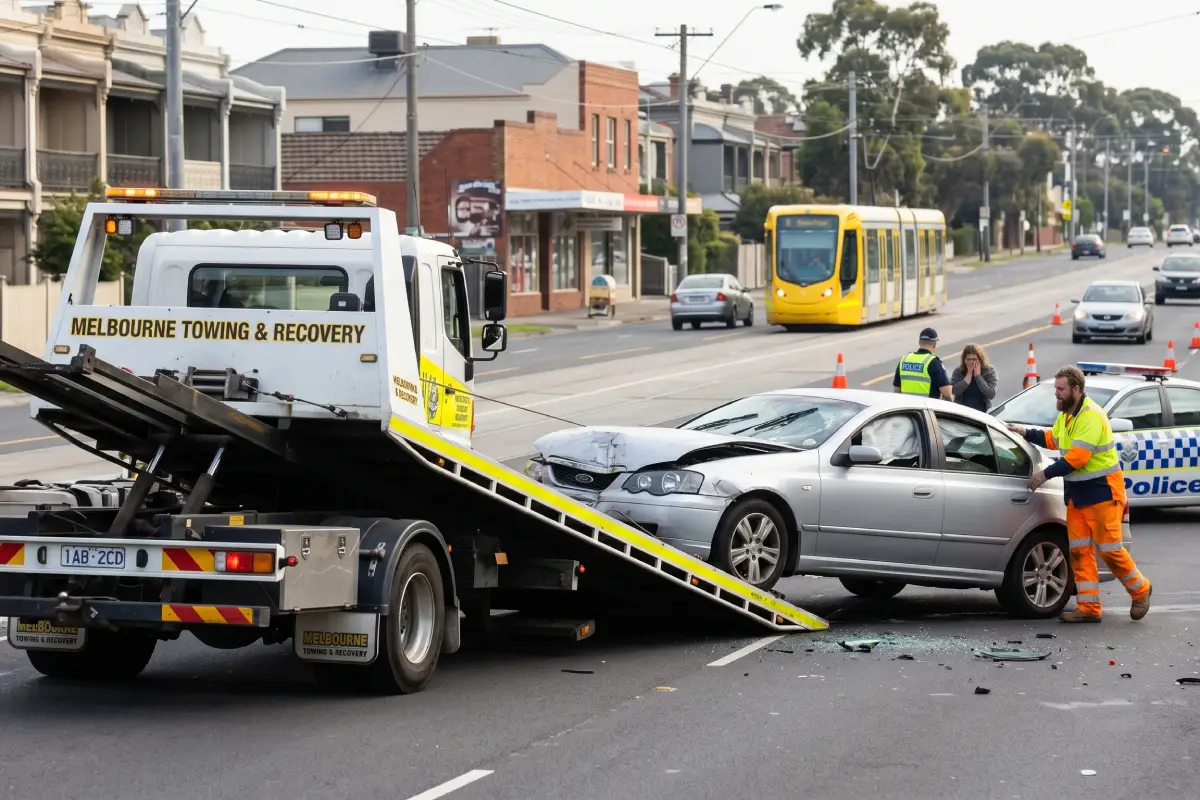
Regulated accident towing and storage fees for metropolitan Melbourne carry a current base fee of $272.80, covering the first 8 kilometres of towing. This base fee includes more than just the drive.
It covers travel from the depot to the accident scene and from the scene to the address on the Authority to Tow, plus debris removal, tow truck cleaning, waiting time at the scene, phone calls, and administration, such as photos and documentation. Travel beyond 8km is charged per additional kilometre.
After-hours surcharges apply for tows that happen outside standard business hours.
These surcharges apply from 5 pm to 8 am Monday to Friday, from 5 pm Friday to 8 am Monday, and on public holidays. If your accident happens on a Friday night, expect the surcharge on top of the base fee.
Storage fees accrue daily while your accident-damaged vehicle sits at the depot.
Storage costs $29.00 per day for a car kept under cover, or $19.60 per day for a car in a locked, uncovered yard. Motorcycle storage is significantly cheaper at $9.60 under cover or $6.10 in a locked yard.
These fees are not arbitrary. The Essential Services Commission’s four-yearly review found the current regulated fees appropriate, noting they’re broadly in line with regulated towing fees in Sydney, Adelaide, and Queensland. Fees are adjusted annually through indexation rather than ad hoc increases.
Clearway and Tow-Away Zone Release Fees
This is the fee category that catches most drivers off guard. It has nothing to do with accidents.
If the City of Melbourne tows your car from a clearway or tow-away zone, the initial release fee is $490, made up of a $490 base component along with separate charges if a second tow or extended administration applies. The full breakdown matters here because the fee escalates fast.
If you don’t collect your vehicle within 14 days, it moves to an overflow yard and the release fee jumps to $956, comprising a $490 initial fee, a $156 second tow fee, and a $310 administration fee. Every day you wait past the deadline costs you more.
On top of the release fee, you’ll also receive a separate parking infringement.
Clearway and tow-away zone violations incur a parking fine in addition to the release fee, and that fine is posted to the vehicle’s registered owner. The towing cost and the fine are billed and processed separately.
This combination of release fee plus fine is why a single wrong parking decision in Melbourne can total close to $800 to $1,000 once everything is paid.
Clearways vs Tow-Away Zones: What’s the Difference
These two terms get used interchangeably, but the legal consequences are different, and knowing the difference matters if you’re disputing a fine.
A clearway is a section of road where parking and stopping are not allowed at the times shown on the clearway sign. If no times are shown, the clearway applies 24 hours a day. Stopping in a basic clearway gets you fined, but historically did not always mean an automatic tow.
A tow-away zone is a section of road where parking is not allowed at certain times shown on the sign. Parking illegally there means your vehicle may be towed, and you may also be fined. The keyword is “may”: towing is the enforcement tool, the fine is the legal penalty.
The distinction has narrowed sharply since 2020.
Before this change, a car left in either a clearway or a tow-away zone was illegal, but only the tow-away zone allowed the vehicle to actually be removed. Since then, Transport Victoria has converted nearly every major clearway near the CBD into a tow-away zone, closing that loophole entirely.
The geographic rule to remember is simple.
All clearways on major roads within 20 kilometres of Melbourne’s CBD are now tow-away zones, meaning your vehicle can be towed and impounded if it blocks one during restricted times. Outside that 20km radius, ordinary clearway rules may still apply without automatic towing.
Where Melbourne’s Tow-Away Zones Are
Tow-away zones aren’t evenly spread across Melbourne. Some councils have dramatically more than others, which matters if you’re driving through an unfamiliar suburb.
The council areas with the highest concentration of tow-away zones are Boroondara with 37, followed by Darebin with 36, Yarra with 35, Maribyrnong with 26, Banyule with 25, and Stonnington with 23. If you regularly drive through these municipalities, the odds of encountering a tow-away zone are meaningfully higher.
The total scale across metropolitan Melbourne is substantial.
There are 326 clearways carrying tow-away status on major roads within 20 kilometres of Melbourne’s CBD. No new clearways were created as part of this expansion. Existing ones simply gained tow-away enforcement power.
A few councils handle their own enforcement entirely outside this state system.
The City of Melbourne and the City of Port Phillip run their own separate towing and infringement arrangements, and you’ll need to contact them directly if your vehicle is towed from either municipality. This matters because the contact number and process differ from the state-run system covering the other tow-away zones.
What Happens When Your Car Gets Towed
The process follows a fixed sequence designed to create a paper trail before your car ever leaves the ground.
The tow truck operator completes an ‘authority to tow’ form and takes multiple geotagged photos of the vehicle before towing begins. This documentation protects both you and the operator if the tow is later disputed.
There’s a brief window where you can stop the process if you return in time.
If the driver has not returned to the vehicle before towing commences, the vehicle is towed away. If you return while the tow truck is still in the area, you may be able to pay a fee and have your car released at the nearest safe location instead of being taken to the impound yard.
Once towed, your car goes to a specific holding location depending on where it was picked up.
Vehicles towed from City of Melbourne Clearway and Tow Away zones are taken to the Melbourne impound yard at 34 Cromwell Street, Collingwood. Vehicles towed under the broader state system in other municipalities are held by the contracted operator instead.
How to Find and Collect Your Towed Vehicle
The first step is confirming whether your car was actually towed, and by whom.
You can check Nationwide Towing & Transport’s records by entering your registration details online, or call 13 48 69 to find out where your car is impounded. For City of Melbourne tows specifically, you can search by registration online or call 134 869, then phone again to confirm impound staff know when you’re attending.
Bring the right paperwork before you arrive, since impound yards won’t release a vehicle without proof of ownership.
A valid driver’s licence, vehicle registration, and payment method covering the release fee are the baseline requirements at any Victorian impound yard. Some yards also require proof of insurance.
Timing affects your final bill directly.
After 14 days, vehicles towed from Clearway and Tow Away zones move to an overflow yard, which raises the release fee to $956. Collecting your car within the first two weeks avoids this jump entirely.
Can You Dispute a Tow or Fine
Yes, but the tow itself and the fine are reviewed through separate channels, and you need to address both if you believe neither was justified.
To contest the towing fee specifically, you can write to the Department of Transport and Planning if you think your vehicle shouldn’t have been towed, emailing the Clearway Towing Administrator and providing the date, time, location of the tow, and your reasons for the dispute.
To contest the parking infringement itself, you can request an internal review, have the matter heard in court, or email the relevant department explaining why you believe the fine was unwarranted, including fine details such as where and when it occurred.
The City of Melbourne handles refund requests for its own impound fees under a narrower set of circumstances.
Refunds may be considered in exceptional circumstances, such as a situation that reasonably prevented you from parking legally, like a medical emergency or a vehicle breakdown, supported by independent documents rather than a statutory declaration. Have evidence ready before you submit anything.

How to Avoid Getting Towed in Melbourne
The single most common cause of getting towed isn’t reckless parking. It’s misreading a sign during the wrong hours.
Check the time restrictions printed directly on clearway and tow-away signs before you park, every time, even on a street you park on regularly. Restrictions often apply only during weekday peak hours, meaning the same spot is legal at 10 am and illegal at 4 pm.
Avoid assuming a spot is safe just because other cars are parked there. Enforcement sweeps happen in batches, and a street full of parked cars at 3:55 pm can be empty by 4:15 pm during the restricted window.
If you’re unfamiliar with a suburb, exercise caution toward inner and middle-ring municipalities.
Boroondara, Darebin, Yarra, Maribyrnong, Banyule, and Stonnington carry Melbourne’s highest concentration of tow-away zones, so extra sign-checking in these areas is worth the thirty seconds it takes.
Melbourne Towing Fee Summary
| Fee Type | Amount | Applies When |
| Accident towing base fee | $272.80 (first 8km) | Tow truck attends a road accident |
| Accident storage (car, under cover) | $29.00/day | Vehicle held at depot post-accident |
| Accident storage (car, locked yard) | $19.60/day | Vehicle held at depot post-accident |
| Clearway/Tow-Away release fee | $490 | Standard collection within 14 days |
| Clearway/Tow-Away overflow release fee | $956 | Collection after 14 days |
| Parking infringement | Separate fine | Always issued in addition to towing fee |
Conclusion
Melbourne’s towing fees are split into three distinct systems: regulated accident towing starting at $272.80 for the first 8km, clearway and tow-away zone release fees starting at $490 and escalating to $956 after 14 days, and deregulated trade towing where operators set their own prices.
Tow-away zones now cover nearly every major clearway within 20km of the CBD, with Boroondara, Darebin, and Yarra carrying the heaviest concentration. The fastest way to avoid the cost entirely is reading the time restrictions on the sign before you park, since most tows happen from misreading timing rather than ignoring signage.
If it’s too late for that and your car is already gone, confirm the impound location by registration lookup, gather your licence and registration, and collect within 14 days to avoid the overflow fee.